Longer, hotter UK summers are increasing the risk of wildfires across woodlands, heathlands and nature reserves. As a result, landscape architects, engineers and local authorities are placing greater emphasis on resilient materials that can withstand increasingly unpredictable environmental conditions.
Why Fire Resistance Matters
Whether it’s a countryside boardwalk, a coastal walkway or a pedestrian bridge through woodland, outdoor infrastructure becomes increasingly vulnerable to fire during extended periods of dry weather.
Traditionally, timber has been the material of choice for many boardwalks and pedestrian bridges because of its natural appearance. However, it’s inherently combustible and over time, is also susceptible to rot, moisture and deterioration. During periods of more severe weather, these factors place greater requirements on the long-term resilience of the materials being specified.
A Fire-Resistant Alternative to Timber
GRP has become a popular alternative to traditional timber because it has been engineered specifically to perform in demanding outdoor environments.
Polydeck’s bridges, boardwalks and planks are manufactured from thermoset GRP, a material that offers a unique combination of durability, stability and safety. Unlike thermoplastics, thermoset GRP does not soften, warp or distort during periods of high temperatures, making it well suited to the increasingly warm conditions experienced across the UK.
Crucially, Polydeck’s products are also self-extinguishing and fire resistant to BS 476 Part 6 and Part 7 Class 1, providing superior fire performance compared to traditional timber structures.
However, fire resistance is only one part of the equation. Polydeck’s products are also designed with a service life in excess of 75 years, helping reduce maintenance requirements, minimise replacement cycles and lower lifetime costs. Manufactured with a structural GRP outer shell and a recycled PET plastic bottle foam core, they will not rot, corrode or deteriorate when exposed to wet, coastal or flood-prone environments.
Taken together, these characteristics work to create infrastructure that is designed to withstand environmental challenges throughout its entire design life.
Fire Resistance Without Compromising on Appearance
Whether installed within a woodland, coastal nature reserve or public park, bridges and boardwalks should enhance access without detracting from the environment they are designed to protect.
That’s why Polydeck’s timber-effect GRP finish has been developed to replicate the appearance and texture of natural wood while delivering the long-term performance benefits of engineered composite materials. The result is a bridge or boardwalk that blends seamlessly into the landscape, without the maintenance issues, splintering, distortion or limited lifespan associated with traditional timber.
As public infrastructure is expected to perform for long periods of time, material selection has never been more important. Fire resistance forms part of a broader approach to designing resilient, sustainable infrastructure that can continue to perform safely and help to help future-proof public access routes without compromising the landscapes they are designed to serve.
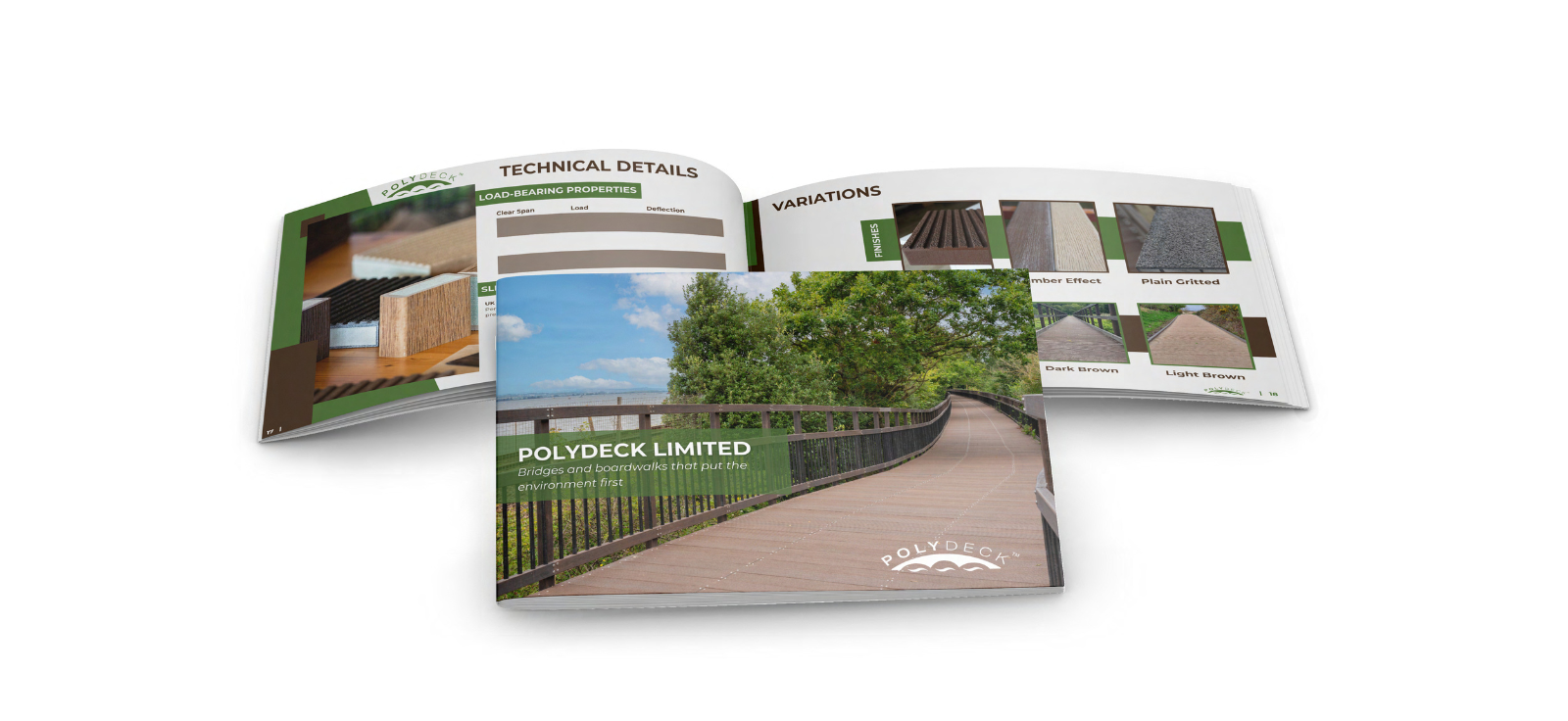
Brand new brochure for 2026
To explore the full range of features, technical specifications, design standards and case studies, download our latest Product Brochure and Technical Specification Guide. You’ll find everything you need to understand how Polydeck’s GRP solutions are helping engineers, landscape architects and local authorities future-proof infrastructure across the UK.